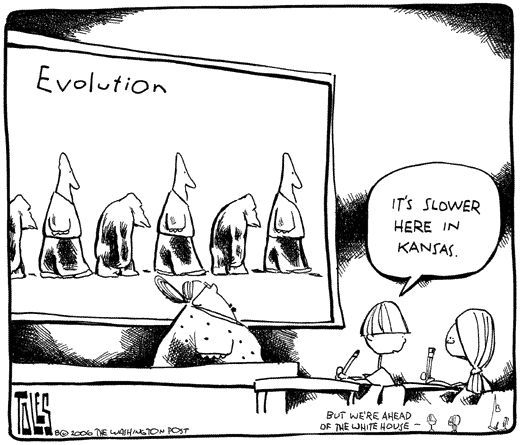


Demagogic Kansas governor associated state school board with hate group
A news article last year said,
At the time I read the article, I was not aware how nasty Phelps's anti-gay group is -- now I know. Darwinist Gov. Sebelius's demagoguery is despicable.
READ MORE
Topeka — Calling her an “elitist” and a “big-government liberal,” the state school board’s chairman on Friday criticized Gov. Kathleen Sebelius over her proposal to strip the board of its power to set education policy.
Steve Abrams, an Arkansas City Republican who is part of the Kansas State Board of Education’s conservative majority, took the Democratic governor to task for suggesting that its adoption last year of science standards seen as anti-evolution had damaged Kansas’ economic development efforts.
Abrams also attacked Sebelius for saying that the state has to deal with negative publicity created by the board, just as it does with the anti-gay picketing of the Rev. Fred Phelps Sr. and his followers.
“The governor owes the Kansas State Board of Education as well as the citizens of the state of Kansas an apology,” Abrams said in a statement sent by e-mail to news organizations across the state. “Personal insults from this liberal governor are the only arguments she can make due to the lack of her own accomplishments.”
“I expect a big-government liberal like our governor to oppose conservative politics. But to infer that the State Board of Education is responsible for the lack of economic development in Kansas is laughable,” he added.
At the time I read the article, I was not aware how nasty Phelps's anti-gay group is -- now I know. Darwinist Gov. Sebelius's demagoguery is despicable.
Labels: Kansas controversy
READ MORE
posted by Larry Fafarman | 11/07/2007 04:00:00 PM
|
1 comments